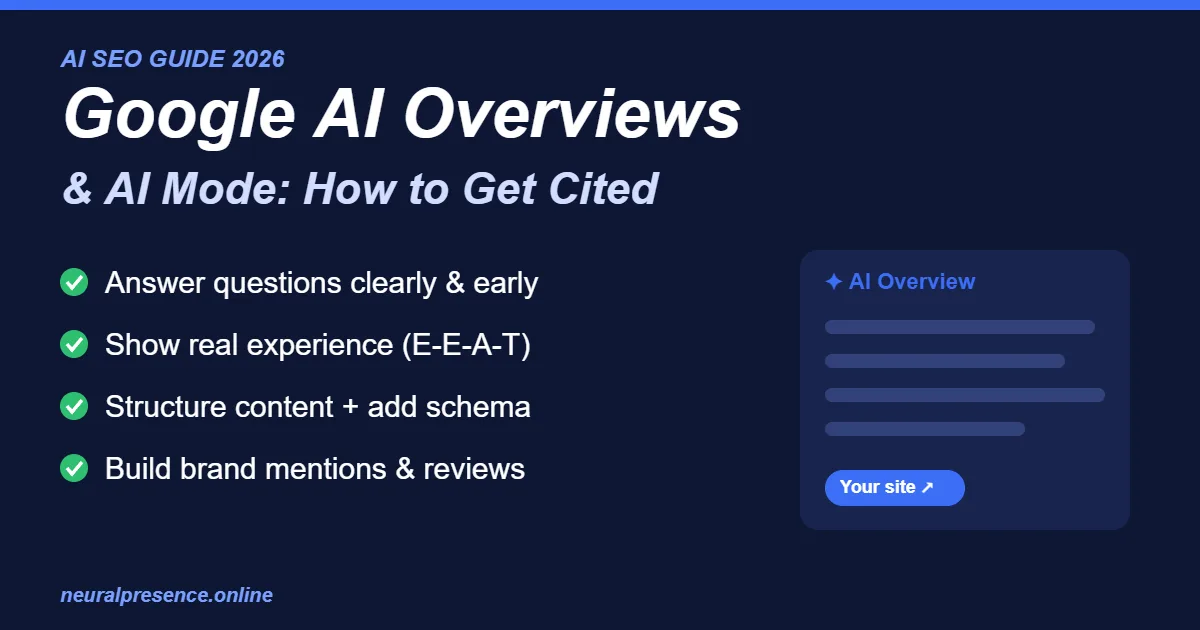
Search is changing faster than at any time in the last twenty years. When people in Kolkata — or anywhere — type a question into Google today, they often see an AI-written summary at the top of the page before any website link. These are Google AI Overviews, and alongside them Google now offers AI Mode, a full conversational search experience powered by Gemini.
For businesses, this raises an urgent question: if Google answers the question itself, how do customers still find my website? The good news is that AI-powered search still relies on websites as its sources. In this guide, we explain how Google AI Overviews and AI Mode work, what has changed for SEO in 2026, and the practical steps you can take to get your business cited in AI answers.
Table of Contents
What Are Google AI Overviews and AI Mode?
Google AI Overviews
Google AI Overviews are AI-generated summaries that appear at the top of some search results. They give a quick answer to the query and include links to the web pages that Google used as sources. They usually appear for informational and “how to” questions, comparisons and multi-part queries.
Google AI Mode
AI Mode goes a step further. Instead of a list of blue links, the searcher gets a conversational, AI-written response and can ask follow-up questions — much like chatting with an assistant. Sources are still cited, but they appear as links and cards within the answer rather than as a traditional ranking list.
Other AI Search Tools
Google isn’t alone. Many people now also search using ChatGPT, Gemini, Perplexity and Microsoft Copilot. Optimizing for AI answers across these platforms is often called Generative Engine Optimization (GEO) or AI SEO.
How Google AI Overviews Change SEO in 2026
- Fewer clicks for simple questions: when the answer is shown directly on the results page, some searchers don’t need to click. Basic definitions and quick facts are the most affected.
- Being cited matters as much as ranking: appearing as a source inside an AI answer builds visibility and trust, even when you aren’t the first blue link.
- Higher-quality clicks: people who do click through from an AI answer often want more depth, a service or a quote — so they tend to be closer to taking action.
- Brand and trust signals carry more weight: AI systems favour sources that look credible, specific and well-established.
- Local intent still matters: for “near me” and service-in-a-city searches, Google still draws on Google Business Profiles, reviews and local websites.
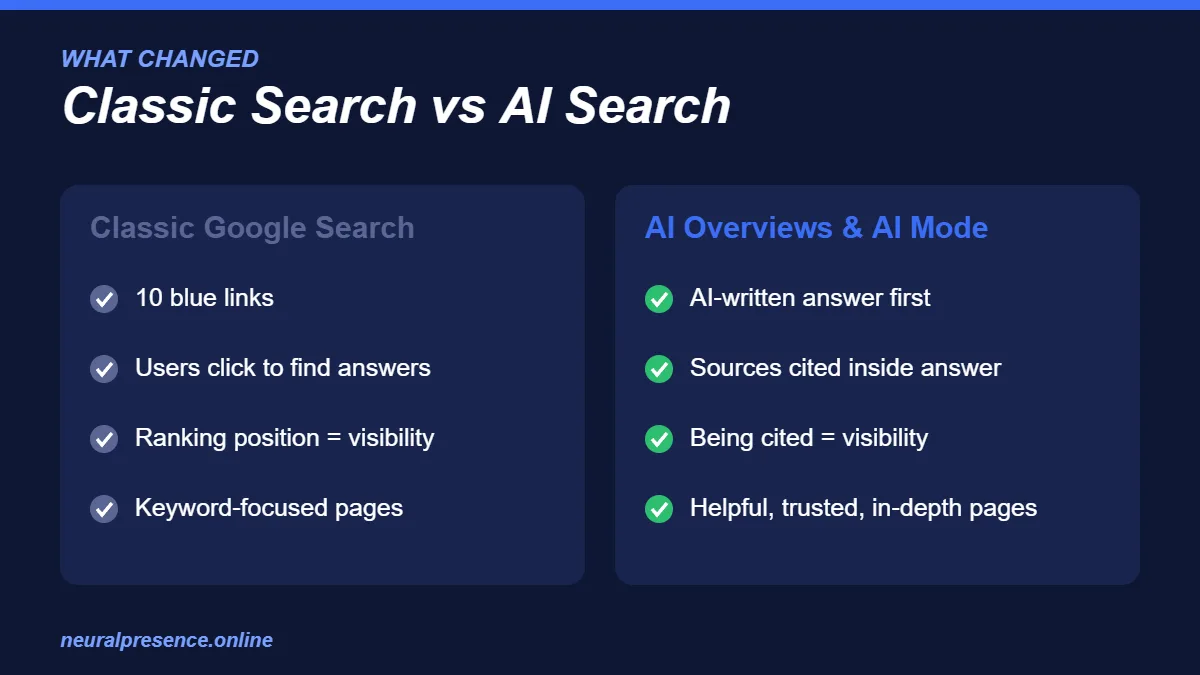
In short, SEO isn’t dead — it has become more about being the most useful and trustworthy source on a topic.
How Does Google Choose Sources for AI Overviews?
Google has said that there are no special technical requirements to appear in AI Overviews or AI Mode beyond normal SEO best practice. According to Google Search Central’s guidance on AI features, a page must be indexed and eligible to show a snippet in Google Search to be used as a supporting link.
In practice, the pages that get cited tend to share a few qualities:
- They directly answer the question clearly and early on the page.
- They show experience and expertise — real examples, original insights and a credible author.
- They are well-structured with clear headings, lists and tables that are easy to extract.
- They are technically healthy — crawlable, fast, mobile-friendly and indexed.
- They come from a trusted brand that is mentioned and linked across the web.
9 Ways to Rank in Google AI Overviews and AI Mode
1. Answer the Question in the First Few Lines
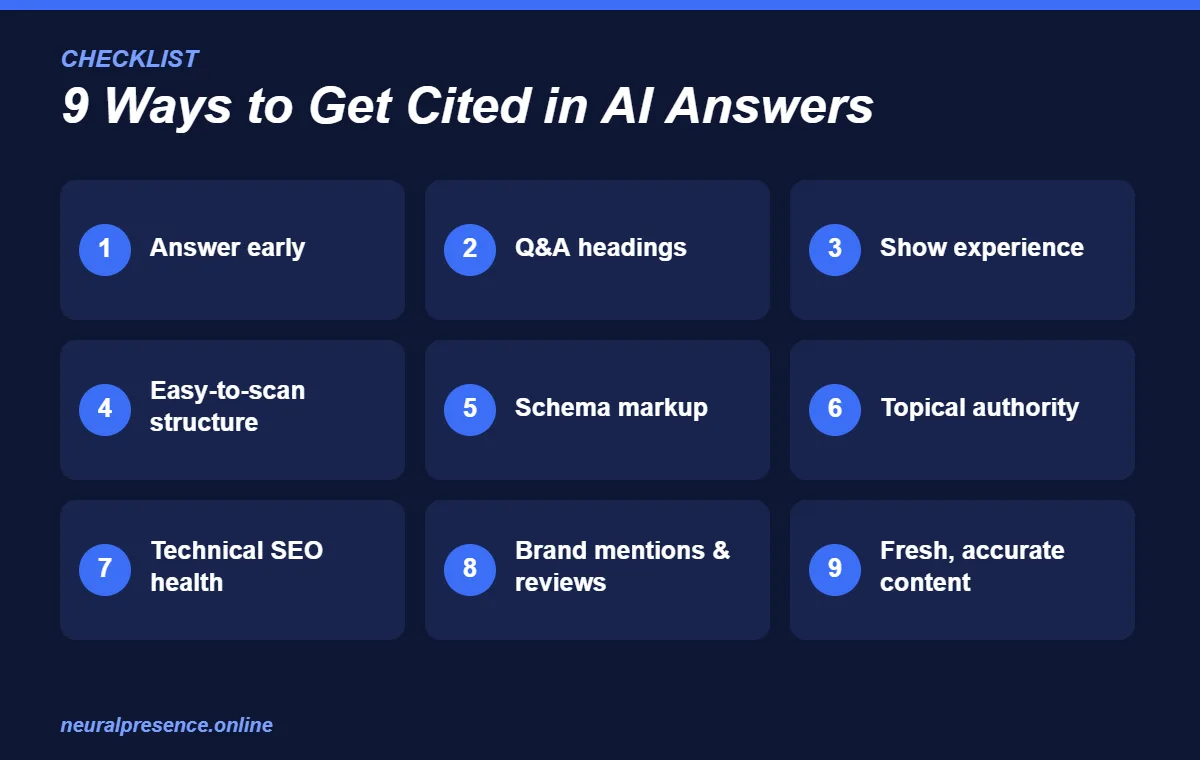
Start each important section with a direct, two-to-three sentence answer, then expand with detail. If someone searches “how much does a website cost in Kolkata”, your page should give a clear answer near the top — not after five paragraphs of introduction.
2. Write in Question-and-Answer Format
Use real customer questions as H2 and H3 headings: “How long does SEO take?”, “Is Google Business Profile free?” and so on. Tools like Google’s “People also ask” box, Google Search Console queries and the questions your sales team hears every day are excellent sources.
3. Show Real Experience (E-E-A-T)
Google’s quality guidelines emphasise Experience, Expertise, Authoritativeness and Trustworthiness. Add details only you can provide: project results, photos of your work, local examples, pricing ranges and lessons learnt. Include an author name and short bio on every article. Generic, rewritten content is much less likely to be cited.
4. Structure Content So It’s Easy to Extract
- Use one clear H1 and logical H2/H3 headings.
- Keep paragraphs short (two to four sentences).
- Use bullet points, numbered steps and comparison tables.
- Add a table of contents to long guides.
5. Add Schema Markup
Structured data helps search engines understand your content. Useful types include Article, FAQPage, HowTo, LocalBusiness, Product and Review. Schema doesn’t guarantee a citation, but it removes ambiguity about who you are and what your page covers.
6. Cover Topics in Depth (Topical Authority)
Instead of one thin page per keyword, build a topic cluster: a main guide plus supporting articles that answer related questions, all linked together. For example, a main SEO services page supported by guides on local SEO in Kolkata, technical SEO and content writing. This shows Google that your site is a reliable source on the whole subject.
7. Keep Your Technical SEO Healthy
- Make sure important pages are indexed in Google Search Console.
- Don’t block Googlebot in robots.txt or with noindex tags by mistake.
- Improve page speed and Core Web Vitals.
- Make every page mobile-friendly.
- Use clean, descriptive URLs and fix broken links.
8. Build Brand Mentions and Reviews
AI systems learn which brands are trusted from across the web. Earn mentions in local news, industry directories and partner websites; collect genuine Google reviews; and stay active on LinkedIn, YouTube and other platforms where your customers spend time. A strong, consistent brand name everywhere makes it easier for AI tools to recognise and recommend you.
9. Keep Content Fresh and Accurate
Update key pages regularly with current prices, new examples and the latest information, and show a “last updated” date. Outdated content is less likely to be trusted — by both people and AI.
AI SEO for Local Businesses in Kolkata
If you serve customers in Kolkata, AI search can actually work in your favour. When someone asks an AI tool for “the best interior designer in Salt Lake” or “a reliable CA firm in Park Street”, the answer is shaped by local signals:
- A complete, active Google Business Profile with photos, services and posts.
- Plenty of recent, genuine reviews that mention your services and area.
- Consistent name, address and phone number across directories.
- Location-specific pages on your website that answer local questions.
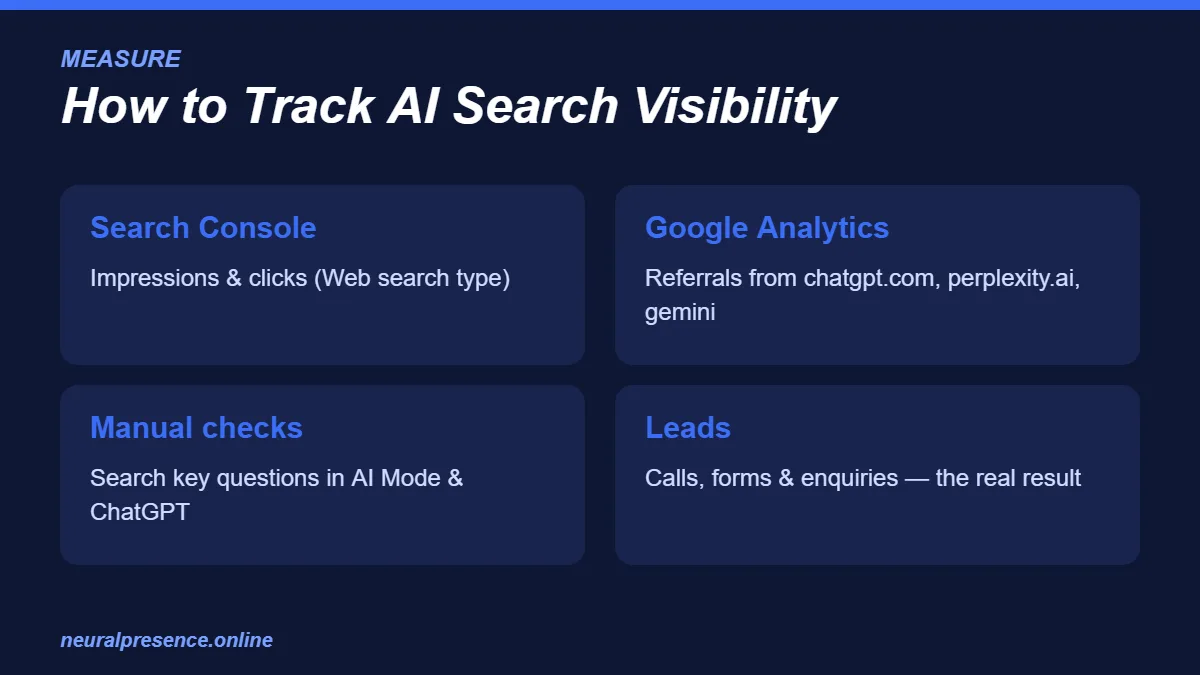
How to Track Your Visibility in AI Search
- Google Search Console: AI Overviews and AI Mode traffic is included in your Performance report under the “Web” search type. Watch impressions as well as clicks.
- Google Analytics: monitor referral traffic from AI tools such as chatgpt.com, perplexity.ai and gemini.google.com.
- Manual checks: regularly search your most important questions in Google, AI Mode and ChatGPT, and note whether your brand is mentioned or cited.
- Leads, not just traffic: measure enquiries, calls and form submissions — the real business result.
Common AI SEO Mistakes to Avoid
- Publishing large volumes of unedited AI-generated content with no original insight.
- Hiding the main answer deep inside long, vague introductions.
- Ignoring technical problems that stop pages from being indexed.
- Using different business names across your website, profiles and directories.
- Chasing traffic alone instead of conversions and brand visibility.
Frequently Asked Questions About Google AI Overviews
Is SEO dead because of Google AI Overviews?
No. AI Overviews and AI Mode are built on top of Google’s search index and cite websites as sources. Good SEO — helpful content, strong technical health and trusted brand signals — is what makes a page eligible to be cited.
Can I pay to appear in Google AI Overviews?
You cannot pay to be cited as a source in an AI Overview. Google Ads can appear in or around AI results, but organic citations are earned through content quality and SEO.
Do I need special code or markup to appear in AI Overviews?
No special code is required. Your page needs to be indexed and eligible to show a snippet in Google Search. Structured data is still helpful because it makes your content easier to understand.
What is GEO (Generative Engine Optimization)?
GEO is the practice of optimizing your content and brand so that AI-powered tools such as Google AI Overviews, AI Mode, ChatGPT and Perplexity mention or cite you in their answers. It builds on traditional SEO rather than replacing it.
Can I stop Google from using my content in AI Overviews?
You can limit how much of a page is shown using snippet controls such as the nosnippet or max-snippet robots directives. However, this can also reduce how your page appears in regular search results, so most businesses benefit more from being visible.
Get Your Business Ready for AI Search
Google AI Overviews and AI Mode reward businesses that are genuinely helpful, clearly structured and widely trusted. Focus on answering real customer questions, showing your experience, keeping your website technically sound and building your brand across the web.
Want help adapting your website for AI-powered search? Explore our SEO services and content writing services in Kolkata, or book a free AI SEO consultation — call us at +91 70033 56833.

Leave a Reply